José F. Grave de Peralta

SAINT PIERRE FAVRE,
San Francisco Xavier
and San Ignacio de LOYOLA

Pierre Favre gives Holy Communion to Francis Xavier, Ignatius of LOYOLA, and an acolyte
oil on panel , 1 meter x 1 meter
2025
In January 2025, a Belgian priest named Jean-Pierre Sonnet passed by my Rome studio to say Happy New Year and invite me to follow him to the Collegio Roberto Bellarmino Residence for seminarian students, where he resides as well. Jean-Pierre and I had met some years back when in passing by my small shop, he saw a watercolor painting of the Piazza Sant' Ignazio, where my street begins, and meets his residence on Via del Seminario. Now, Fr. Jean-Pierre wanted me to see the small communion chapel in one of the inner halls of the building, to see if I would be interested in painting a scene of the three founders of the JESUIT Society of Jesus, as one of them -- PIERRE FAVRE, or FABER, gave Holy Communion to his two closest friends while the three of them studied in Paris in the first quarter of the 1500s. As a possible idea for my painting, to be done in somewhat large format, preferably in, oil, Fr. Jean-Pierre said he would show me a print (see below) of a work from the time of the meeting and friendship of the young men, which I was certainly permitted to reproduce in larger format.
Ignatius of Loyola used to say that PIERRE FAVRE conducted the best Spiritual Exercises, and that he was a Man of God, and a passionate believer in the power of conversation to help souls and transform the heart. Pierre Favre (1506-1546) is the patron saint of the French-speaking Jesuit Province of Western Europe.
He was born to a family of shepherds in Villaret, a small village of the French Alps. In 1525, Faber went to Paris to pursue his studies. He was admitted to the Collège Sainte-Barbe, the oldest school in the University of Paris, where he shared his lodgings with Francis Xavier. He had little education, but a remarkable memory; he could hear a sermon in the morning and then repeat it verbatim in the afternoon for his friends. Pope Francis announced his canonization in 2013, having been beatified in 1874 by Pope Pius IX, "Pio Nono."
While studying in Paris, Faber's spiritual views began to develop, influenced by a combination of popular devotion, Christian humanism, and late medieval scholasticism. Faber and Xavier became close friends and both received the degree of Master of Arts on the same day in 1530. At the university, Faber also met Ignatius, and became one of his associates. He tutored Loyola in the philosophy of Aristotle, while Loyola tutored Faber in spiritual matters.Faber wrote of Loyola's counsel: "He gave me an understanding of my conscience and of the temptations and scruples I have had for so long without either understanding them or seeing the way by which I would be able to get peace.
Ignatius de Loyola sent Faber as theologian to the Council of Trent, called by the Catholic Church of Rome in the year 1534, to address the critical situation posed to Catholicism by Martin Luther's Protestant Reformation. Faber travelled on foot throughout France, Germany, and Italy during those years, and in Rome, he and his peers preached in some of the major churches where Catholic priests were to all effects preaching "Lutheran" ideas to their congregations.
Xavier, Faber, and Loyola are recognized by the Jesuits as founders of the Society of Jesus.
https://www.jesuites.com/saint-pierre-favre-sj-2/
https://en.wikipedia.org/wiki/Peter_Faber

Pierre Favre
by André Nazé , S.J.
print reproduction
2025
I was very honored and elated.
Several days later, I had the opportunity to see other areas of the building where the chapel is, to give me ideas of color and craftsmanship approach for my painting, and this allowed me to think about my work in context and in harmony with the general atmosphere of the seminary's areas of gathering and daily activity. As the days flowed on, Jean-Pierre passed by my studio on several other occasions to see some first sketches that I produced, mostly in pencil or charcoal, as I began to read more about Saint Pierre Favre, who was to be especially important in my composition -- and perhaps in a slightly different "size relationship" to the young men depicted in the 1595 canvas by Pierre Nazé (shown above).
What followed was quite special, and to me unexpected: my "croquis" or gesture drawings of the scene started spinning in variant directions, but in the end we were both in accord about the positioning of the figures in my design, and about the inclusion of books, a walker's staff. We decided alo that 0n the right edge, there would appear an iconic representation of three of the main areas of the world that Ignatius, Francisco, and Pierre would have talked and dreamed about most often: 1500s Paris, Rome, and the Great Wall of China.The three iconic regions or cities are stacked from bottom to top in that last quarter of the square oil painting on wood.
Once we narrowed down the variants to what was to be the final work, I produced a small pastel version of the work, using the brown color of the wrapping paper as the dominating chrome, plus white, black, some orange and red, and the hue of blue that frames the scene, as if the Communion scene was a painting affixed to a base that was that blue itself.
The painting process took up an unforgettable 6 months of time. The work now hangs inside the "Saint Pierre Favre Communion Chapel" in the Roberto Bellarmino Residence for Jesuit seminarians, located a block away from the Church of San Ignazio, on Via del Seminario, in ROME.


Final color PASTEL sketch first marks of the color PASTEL sketch
40 cm x 40 cm (16" x 16") (I use what Leonardo coined "macchia" or stains
and rub, erase with kneaded eraser, etc.)
Drawing or Imposing a GRID on the final (PASTEL) sketch
facilitates the enlargement or the transfering of a design or composition to a larger format
Playing battleship, in a sense and the premise that "a square is a square is a square" ... the location of figures or elements in a mother/father square "a" by analogy, must be the same in the child or "A" square ...
In my project I was going to a larger dimension of a wooden panel in OIL, so after the panel was sufficiently smooth and its gesso surface was also smooth, I gave it some four or five coats of the tone of OCHRE of the pastel paper, and when it dried I was ready to draw the larger grid with white chalk, making sure the parallel verticals and horizontals were straight and fine.
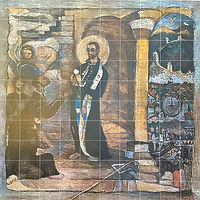


(Note that the GRID lines were black!) These two photos show earlier and later moments of the transference
(I use what Leonardo coined "macchia" or stains . . . , in this case, using a cloth dipped in Turpentine to erase, or "scoop" out the dark to make way for the figures to emerge as light!).
Working in this way is very forgiving, as the painter can paint dark back in if he repents of a shape that is not altogether correct in the larger oil version.


One of my soft-lead pencil sketches of Saint Francis Xaviour
Reading about him and Ignatius allowed me to feel their personalities so that my thumbnail-size and larger format portrait likenesses felt more true to form. Francisco Javier is usually represented holding back his heart, as a gesture, for in his exaltation while in prayer, he said that his heart always seemed to burst out of his chest.
Jean-Pierre Sonnet, O.S.J.
came by often to see how the work was progressing. His openness and advice were always sensitive and most valuable. My gratitude is sincere!

