José F. Grave de Peralta

Painting in gouache of the Temple of Saturn

![IMG_E0334[1].JPG](https://static.wixstatic.com/media/9cc4ae_c8aefff33dba41e5810118f9320d89a5~mv2.jpg/v1/fill/w_600,h_398,al_c,q_80,usm_0.66_1.00_0.01,enc_avif,quality_auto/IMG_E0334%5B1%5D_JPG.jpg)
In the course of every day occurrences certain situations present themselves which carry many other situations or opportunities within them : simply stated, as concerns this story in my web site, I am referrring to pictures carrying inside them other pictures!
Some time ago, a young gentleman -- he was more than a passer-by, in both dress and manners -- stopped by my drawing studio and asked if I could create in pen and ink technique similar to that of one or two landscapes which he had admired in my window, a design of a cornucopia for a mosaic floor. He explained further that his family was completing the restoration of a building on on Via dei Foraggi -- a street whose name echoed the trades and services available in that area of Ancient Rome, specifically the depot or provider of the feed eaten by the horses pulling the chariots used in the Circus Maximus.
"I would very much like to use your pen&ink idea for the mosaic floor in the foyer of our building, which will be a guest house!" the young shop visitor added with a smile.
The huge "footprint" of the Circus Maximus is quite intact to this day, two or three blocks away from the new residenza.
Some days after that first call, this new client came to pick up the black and white drawing displayed on this page, and, when he did so, I shared with him that I had spent some time looking through a grand coffee-table book titled The Glorious Constellations that I had brought to Rome from Miami, which had told me all about the star group of the cornucopia, which sky gazers read as a symbol of one of the horns of Amalthea, a she-goat who according to the myths of the birth of Zeus and his being sheltered from enemy titans and suckled by this legendary animal in a cave of the island of Crete. Symbol of abundance and hospitality -- the welcome mosaic of the guest house.
All's well that ends well -- or, in fact, that has a happy sequel. Not a month had gone by, according to the Roman calendar, when the client paid a visit again, but this time requesting a sort of fantasy view, or veduta, of the Forum as though viewed from across abundant fields of grain and hay. "Do you think you could paint he temples of old Rome as though growing out of the fields of the fodder sold to the owners of the race horses back in the day."
The plot was thickening. Surely by no mere coincidence, I had recently found in the Libreria dei Cesaretti recent months a readable but scholarly text about the origins of commerce and trade guilds in Rome -- going back to the times of kings Romulus and Numa Pompilio, the Republic, Middle Ages and the years of Italy at the time of World war II! The text gave me very valuable insights into the commercial history of Rome and the almost sacred significance of grain storage and distribution of wheat and oats throughout time -- information that I could weave into my tour excursions to the old Port of OSTIA, and now even into the painting commission for the Via dei Foraggi. After some thought and not a few sketches, my answer to this second request may be appreciated in the color pastel piece shown at the top of this web page. Fortunately indeed, the fantasy of a Roman Forum visually linked to the land and to farming, in pastel, now hangs in one of the walls of the Residence on the Street of Fodder.

Illustration for the Guest Book
Three's the Charm, as they say.
Early in 2026, which is the time frame of the present web page, the courteous young man paid a visit again, but this time, after his cordial greeting, he pulled out of his jacket pocket a business card of the residenza, and asked: "I have another idea. Would you be able to paint in color the temple that appears on our card . . . and that our guests would see when they signed the guest registry ?"
"Do you know which temple this is, José?"
"The Temple of Saturn," I replied, "of course."
The gouache painting of the temple in the video clip above of my took some doing. I paid several sketching visits to the Forum itself, but I had to basically hide the fact that I was drawing. These days guards prefer not to see artists and/or students using large drawing boards or much less watercolor sets to draw the extant remains of column capitals and friezes, no matter if the rest of the tourists are clicking away into their cell phones as if there is no tomorrow.
So I made a bee-line for the pages on the Saturn Temple in my Archaeological Guide to Ancient Rome by Filippo Coarelli, and things clicked, and soon I was bringing Plutarch's histories about the last king of the city, Tarquin the Proud, and his successor at the end of the 500's A.D. -- Publicola -- to learn more about the sanctuary -- so I could compose an image for the "Foraggi Project" which, even in its archaic state now, would resemble the logo of the residence.
The Coarelli text mentioning that in arcahic Latin myths Saturn, the titan father of Zeus, Poseidon, and Hades, etc., having found "hospitality" and shelter on the very mount where his temple is located, when he had been ousted from the heavens. In that remote era, way before the Rome of Romulus and Remus in the 8th century B.C., the cult of Saturnia not only explained but anchored the Roman Forum site in a sort of time before Time. And this was why the construction of the temple by Tarquin the Proud was somehow linked to the wealth of the city in archaic times, and explained why even to the times of Julius Caesar and the booties he brought to Rome in his day from his famous Gallic wars -- in fact, to both that time and into the Late Empire -- had housed the state's treasury.
The pen&ink posted shows one of the first proposals for the guest book -- a composition . . . depicting the sanctuary when in addition to having an enclosure for rituals and cult activities connected to the safeguarding of wealth and to the displaying of laws and notices posted in the public sphere for the citizens, would also convey a storybook kind of narrative, showing the
the characteristic lavic stones of the pavement, as well as wagon wheels and pitchforks used in the fields where the fodder came from.


Illustration for the Guest Book......
color pencil

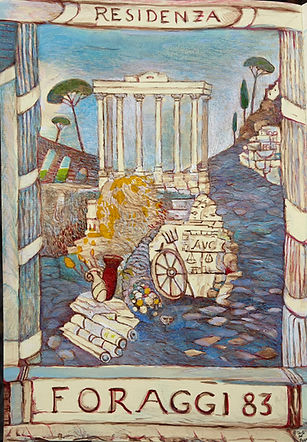
Illustration for the Guest Book
final painting in gouache
AFTERWORD :
The Golden Age as a theme figures importantly in the poetic verses of Ovid's Metamorphosis, and I certainly reread this author's various stories about those epochs as I brainstormed my project. But the way that this blessed time period is sung about by Miguel de Cervantes in one of the early chapters of his novel DON QUIXOTE, Part One, published in 1605, is actually a celebration of HOSPITALITY -- where the protagonist profers his creed to a group of goatherds who have given him and his squire a place to sleep and find plenty of food and wine, in the course of their chivalric wanderings in La Mancha. As they all sit down to enjoy a meal together on stools and tree stumps covered with goats' hides, Quixote toasts to the need to protect and rescue from perils young maidens, widows, and orphans of the world -- exercising the code of knight errantry code. Rereading this episode in Cervantes' novel, I reached for my sketchbook to compose the illustrations shown below. In my pencil and pen&ink images of these chapters, I painted how rustic hosts of the don and his companion graciously listen to Quixote's eulogy of the time before time, where food was abundant for all, greed did not exist, and young maidens and children lived in a peaceful earthly paradise. The don's speech is a remarkable song to yesteryear, and its spirit and purport -- and in my imagination I seated myself inside the text, hoping that the spirit of the passage would inspire the kind of scene that I was looking for in the design of the Temple of Saturn for Via dei Foraggi. Of course, Don Quixote's madness does not hide the fact that he and Sancho were living in times of greed, envy, and disbelief, Modernity, but he explains that the Age of Gold can be revived with chivalry, knight errantry, and, indeed, hospitality -- !


